Australia has taken another significant step in gambling harm prevention. The country’s national self-exclusion register, BetStop, will now expand to cover lotteries and additional gambling verticals — not just online sports betting.
At first glance, this may seem like a technical regulatory update. However, in reality, it represents a structural shift in how governments approach responsible gambling. Instead of regulating individual sectors separately, Australia is moving toward a unified, national safety net.
The natural question for New Zealand is clear: should it do the same?
What Is BetStop — and What Just Changed?
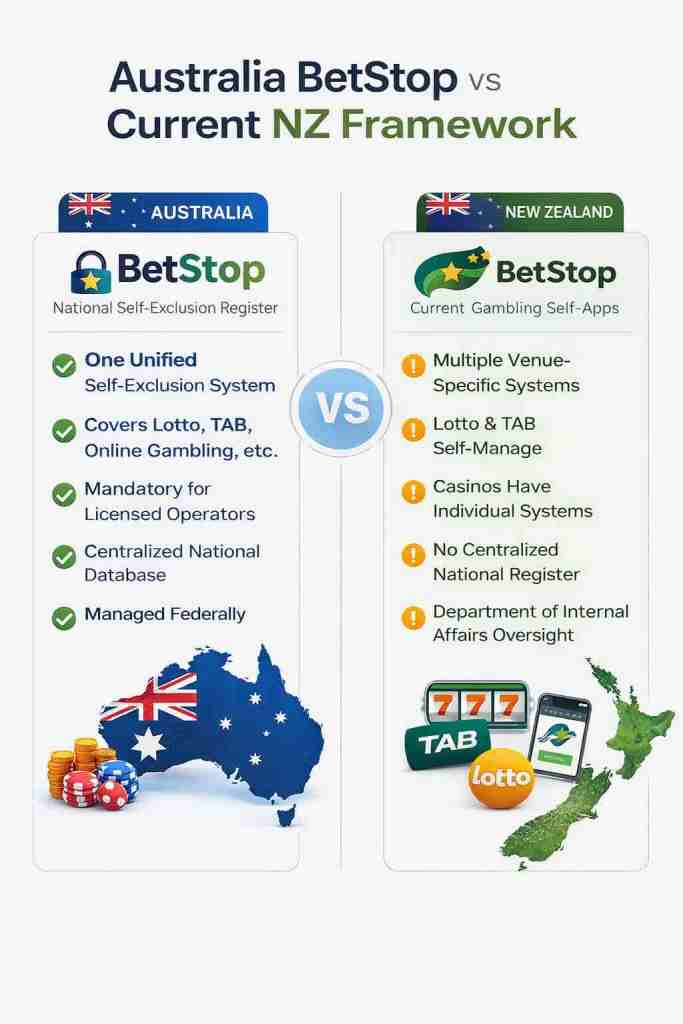
BetStop is Australia’s National Self-Exclusion Register. It launched in 2023 as part of federal gambling reforms and initially applied to licensed online wagering operators.
Under BetStop, individuals can voluntarily exclude themselves from:
- Online sportsbooks
- Digital betting platforms
- Mobile betting apps
Once registered, licensed operators must block access, marketing communications, and account creation for the chosen exclusion period.
Now, Australian authorities are expanding the scheme to include lotteries and other forms of regulated gambling, widening its protective scope.
This is important.
Lotteries are often perceived as “low risk.” However, from a behavioural standpoint, repeated lottery spending can also become harmful. Therefore, integrating lotteries into a national exclusion register signals a broader definition of gambling risk.
Why a Unified System Matters
Historically, gambling regulation has been fragmented.
Sports betting had one framework. Casinos had another. Lotteries operated under separate legislation. Self-exclusion systems were often venue-based rather than national.
This created loopholes.
For example, a person who self-excluded from an online sportsbook could still purchase lottery products without restriction.
A unified system reduces this fragmentation.
From a harm-prevention perspective, centralization increases effectiveness. It prevents individuals from shifting between gambling verticals during vulnerable periods.
Daniel’s View: This Is About Architecture, Not Symbolism
In my view, BetStop’s expansion is less about optics and more about regulatory architecture.
When self-exclusion applies only to certain gambling formats, it becomes reactive. When it applies broadly across all legal gambling products, it becomes structural.
Structural systems are harder to bypass.
That is what makes this development meaningful.
How New Zealand Currently Handles Self-Exclusion
New Zealand already has responsible gambling frameworks in place. However, they operate differently.
Under the Department of Internal Affairs (DIA), land-based casinos and certain venues are required to provide self-exclusion mechanisms.
The New Zealand Lotteries Commission also operates under its own compliance regime, while TAB wagering falls under separate oversight structures.
In practice, this means:
- Self-exclusion is venue or operator-specific.
- There is no fully unified national digital exclusion register covering all verticals.
- Online offshore gambling remains outside direct enforcement reach.
While New Zealand emphasizes harm minimization, its system remains segmented.
The Online Casino Reform Context in New Zealand
This discussion becomes even more relevant given that New Zealand is actively preparing to regulate online casinos domestically.
If licensing is introduced, regulators will face a choice:
- Maintain operator-level self-exclusion systems.
- Create a centralized, national exclusion database similar to Australia’s BetStop.
A centralized model would likely require all licensed operators — including online casinos, sportsbooks, and possibly lottery products — to integrate with a government-managed register.
Such a system would:
- Block marketing to excluded individuals.
- Prevent account creation across all licensed platforms.
- Offer fixed exclusion periods with structured re-entry controls.
This would align New Zealand with global best practices emerging in Australia and parts of Europe.
Should New Zealand Expand Protections to Lotteries?
This is where the debate becomes more nuanced.
Lotteries often occupy a unique regulatory category. They are typically state-operated or state-licensed. They are framed as community-funding mechanisms rather than high-risk gambling.
However, from a behavioural psychology perspective, frequency matters more than format.
If an individual is attempting to pause all gambling activity, the exclusion should logically apply across:
- Online casino products
- Sports betting
- Lotteries
- Instant win games
Otherwise, behavioural substitution occurs.
Australia appears to recognize this. The question is whether New Zealand regulators will adopt the same philosophy.
The Practical Challenges
Creating a unified exclusion system is not simple.
It requires:
- Centralized identity verification
- Cross-operator data sharing
- Secure data protection infrastructure
- Clear enforcement penalties
Additionally, privacy considerations must be addressed carefully. A national register contains sensitive information about individuals who are seeking help.
The administrative burden is significant.
However, the alternative — fragmented exclusion systems — may be less effective.
Offshore Gambling: The Structural Gap
One major complication in New Zealand is offshore gambling.
Even if New Zealand creates a national exclusion system for licensed operators, offshore platforms remain accessible.
This means any domestic exclusion register would:
- Protect users within the licensed ecosystem.
- But not block unlicensed offshore operators.
Australia faces a similar issue. However, expanding BetStop to more gambling verticals strengthens its regulated ecosystem.
New Zealand could adopt a similar layered approach while increasing enforcement pressure on unlicensed operators.
Harm Prevention Is Becoming Pre-Emptive
Regulators globally are shifting from reactive to pre-emptive harm prevention.
Instead of waiting for gambling harm to escalate, governments are introducing structural friction points:
- Advertising restrictions
- Deposit limits
- Affordability checks
- National self-exclusion registers
Australia’s BetStop expansion fits into this broader trend.
If New Zealand is serious about building a modern online casino framework, it will likely need similar safeguards.
What a New Zealand National Register Might Look Like
If implemented, a New Zealand version of BetStop could:
- Be managed by the Department of Internal Affairs.
- Integrate Lotto NZ, TAB, and licensed online casinos.
- Offer minimum 3-month and multi-year exclusion options.
- Require mandatory cooling-off periods before re-entry.
- Include marketing suppression controls.
This would not eliminate gambling harm. However, it would reduce structural leakage between formats.
A Regulatory Crossroads
Australia’s expansion of BetStop to include lotteries is not a small update. It reflects a broader regulatory philosophy: harm prevention must be comprehensive.
New Zealand stands at a crossroads.
With gambling reform on the horizon, regulators have an opportunity to design a modern system from the ground up. That includes deciding whether self-exclusion remains fragmented or becomes centralized.
If the goal is long-term sustainability of a licensed gambling ecosystem, centralized exclusion may be the logical next step.
Australia has moved first.
Now the spotlight shifts to Wellington.