If you’ve ever walked away from a session thinking, “I was so close,” you’re not alone. In fact, that feeling is one of the reasons casinos work so well as businesses. The key thing most players in New Zealand don’t get told plainly is this: every casino game is designed with a built-in advantage for the house. That advantage is called the house edge, and once you understand it, you’ll see online casino games very differently.
This isn’t a scare piece, and it’s not “don’t gamble.” It’s a practical, NZ-focused breakdown of how the math works, why short-term wins can be misleading, and how to choose games with your eyes open.
What “house edge” actually means (in plain English)
House edge is the average percentage of each bet the casino expects to keep over time. So if a game has a 2% house edge, the casino’s long-run expectation is to keep about $2 for every $100 wagered.
Two important clarifications:
- House edge doesn’t mean you can’t win.
You absolutely can win — sometimes big. It just means that if you play long enough, the math pushes the average result toward a loss.
- House edge is about money wagered, not money deposited.
This trips people up. If you deposit $100 but place 200 spins of $1, your total “money wagered” is $200. House edge works on that $200, not your deposit
RTP vs house edge (and why casinos love confusing this)
You’ll often see games advertised with RTP (Return to Player), like “96% RTP.” That sounds generous, right? Here’s the translation:
- RTP 96% = House edge 4%
They’re two sides of the same coin:
- House edge = 100% − RTP
- RTP = 100% − house edge
However, RTP is usually a theoretical number calculated over massive sample sizes (millions of spins/hands). In the real world, your session is tiny compared to that, which is why you can win quickly or lose quickly — even on a “high RTP” game.
The part most people miss: expected loss depends on
Total wagering
Let’s do a simple example that applies to online play in NZ (where mobile sessions often involve lots of quick bets). Say you play a slot with:
- RTP 96% (house edge 4%)
- $1 spins
- 500 spins
Total wagered = $1 × 500 = $500
Expected loss = 4% of $500 = $20
That doesn’t mean you’ll lose exactly $20. It means that on average, across many sessions like this, the result trends toward that. Now here’s the punchline: a bonus that “gives you more spins” increases total wagering — which increases expected loss exposure — unless you’re very careful with limits.
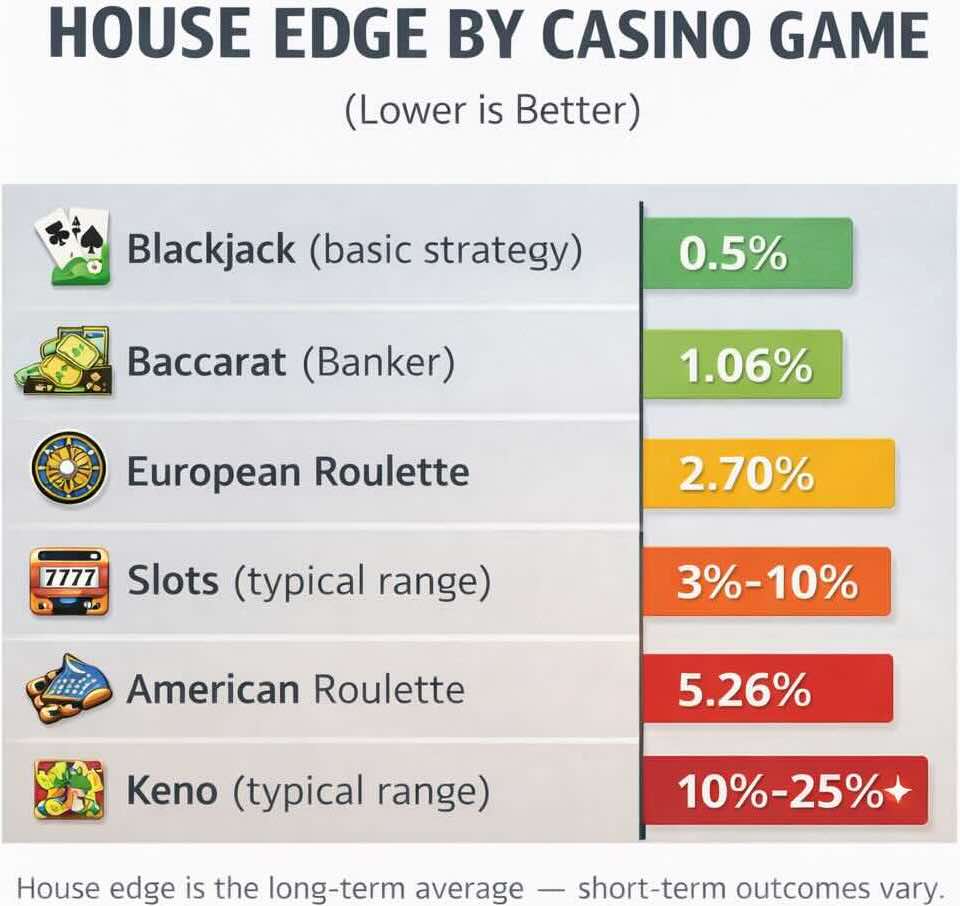
Typical house edge by game (realistic ranges)
These figures are approximate because rules vary by casino and version, but the ranges are directionally correct and genuinely useful when comparing games:
- Blackjack (with correct basic strategy): ~0.5% to 1.0%
- Baccarat (Banker bet): ~1.0% to 1.2%
- European roulette (single zero): 2.7%
- American roulette (double zero): 5.26%
- Slots: commonly 3% to 10% (sometimes more)
- Keno: often 10% to 25%+ (varies heavily)
So, if your goal is to reduce the built-in disadvantage, the “best” games are usually blackjack (played properly) and baccarat banker. Meanwhile, games like keno are fun, but mathematically expensive.
Why “volatility” matters as much as house edge (especially for slots)
House edge tells you the long-term disadvantage. Volatility tells you how wild the ride is.
- Low volatility: smaller wins, more frequent hits, smoother balance movement
- High volatility: longer losing streaks, bigger spikes, more “nothing happens” time
This is why two slots can both show “96% RTP” but feel completely different:
- Slot A might pay small wins constantly
- Slot B might pay nothing for 200 spins and then drop one massive hit (or not)
For NZ players, volatility is often the reason people blow past limits. Long losing streaks feel personal, even though they’re just variance.
“But I’ve had winning weeks” — why short-term wins don’t disprove the math
This is the hardest part emotionally: winning sessions are real, and they’re not rare. If you play enough, you’ll have hot streaks. Casinos expect that.
Think of house edge like a slow downhill slope. Sometimes you’ll sprint uphill and feel amazing. But if you keep walking long enough, the slope shows up.
In other words, variance hides the edge in the short term. The longer you play, the more the edge becomes visible.
Practical “house edge” takeaways that actually help NZ players
If you want the math to work less against you, here’s what matters most:
- Choose low-edge games when possible
Blackjack (basic strategy) and baccarat banker typically sit at the low end.
- Avoid rule variants that quietly increase the edge
For blackjack, rules matter. A “6:5 blackjack payout” is significantly worse than “3:2.”
- Treat slots as entertainment with strict limits
Slots can be fun, but they’re usually not where the math is friendliest. Combine that with high volatility and fast spin speeds, and limits become essential.
- Remember, edge scales with volume
The more you wager, the more the expected loss grows. If you’re chasing losses by increasing stakes or extending sessions, you’re effectively turning up the house advantage exposure.
The point isn’t to “beat the casino” — it’s to play smarter
Once you understand house edge, the whole online casino world becomes easier to navigate. You stop taking losing streaks personally. You recognize that “getting even” is often an emotional trap. And you make game choices based on math — not just vibes.