Expertise: Gambling Analyst, Psychology
- Raids, Records, and the Reshuffling of Global Poker
- From a Texas standoff with regulators to Prague’s record-smashing WSOP Europe debut and the biggest Irish Open in history
- April 2026 is rewriting poker’s map.
There are weeks in poker where the biggest story is a bad beat on a livestream, a prop bet gone sideways, or Phil Hellmuth losing his cool at the table for the fourteen-thousandth time. And then there are weeks like this one — where every corner of the game seems to be moving at once, in ways that actually matter.
April 2026 has barely begun, and already we’ve seen one of the most prominent poker rooms in the United States shut down indefinitely under a cloud of legal uncertainty, a 46-year-old European institution break its own attendance records and announce a global expansion, the World Series of Poker’s European arm relocate to a new city with stunning early results, and the long-awaited merger of PokerStars and FanDuel finally go live in the American market. Oh, and there’s also the small matter of Martin Kabrhel causing trouble in Prague, which is about as surprising as the sun coming up.
Let’s get into it.
The Lodge Raid: Texas Hold’em Meets Texas Law
If you’ve spent any time on poker Twitter — sorry, poker X — over the past month, you already know the contours of this saga. On March 10, approximately 20 agents from the Texas Alcoholic Beverage Commission, accompanied by Williamson County Sheriff’s deputies and IRS investigators, walked into The Lodge Card Club in Round Rock, Texas, and executed a search warrant. Players were reportedly lined up against walls. Cash was seized. Bank accounts were frozen. No charges were filed.
Three weeks later, the situation is this: The Lodge — co-owned by Doug Polk, Brad Owen, and Andrew Neeme — remains closed. All staff, roughly 200 people, have been laid off. The investigation reportedly centres on suspected money laundering and illegal gambling, though the details remain opaque. An April 9 deadline looms: authorities must either file for civil forfeiture of the seized assets or return them. It is, as Polk himself described it in a 22-minute YouTube video released late in March, “a big question mark.”
What isn’t a question mark is Polk’s pledge to personally cover outstanding player funds if The Lodge cannot. He has publicly committed to assuming seven figures in personal liability — not because he’s legally obligated to, he says, but because it’s the right thing to do. That promise, whatever you think of Polk’s occasionally combative public persona, is significant. It tells you two things: first, that the co-owners believe the business model was lawful; and second, that they understand the reputational cost of players losing money in a scenario like this.
The legal grey area at play here is worth understanding. Texas prohibits gambling, but Penal Code Section 47.04 creates a narrow defence for poker games conducted in private settings, where no party receives economic benefit beyond personal winnings, and where all participants face the same risks. Texas poker clubs like The Lodge operate on a membership-and-seat-fee model, collecting no rake from pots — a structure designed to thread this legal needle. Dozens of clubs across the state use some version of the same framework.
The irony, pointed out by many observers, is that The Lodge was licensed by the very same TABC that raided it. The licence was renewed as recently as 2024 under the same operating model. A planned WPT Festival at the venue was postponed in the immediate aftermath, and the wider implications for Texas poker — a state that had become one of the most exciting live poker destinations in the country — remain deeply uncertain.
There is a temptation in moments like these to pick sides — to declare the raid either a justified crackdown or an unconscionable overreach. The truth, as usual, is messier. What we can say is that 200 jobs are gone, player funds are frozen, and the state legislature has had multiple opportunities to clarify the law around social poker clubs and has not done so. The game will survive in Texas. But the people caught in this limbo deserve better than ambiguity.
WSOP Europe Arrives in Prague — and the City Shows Up
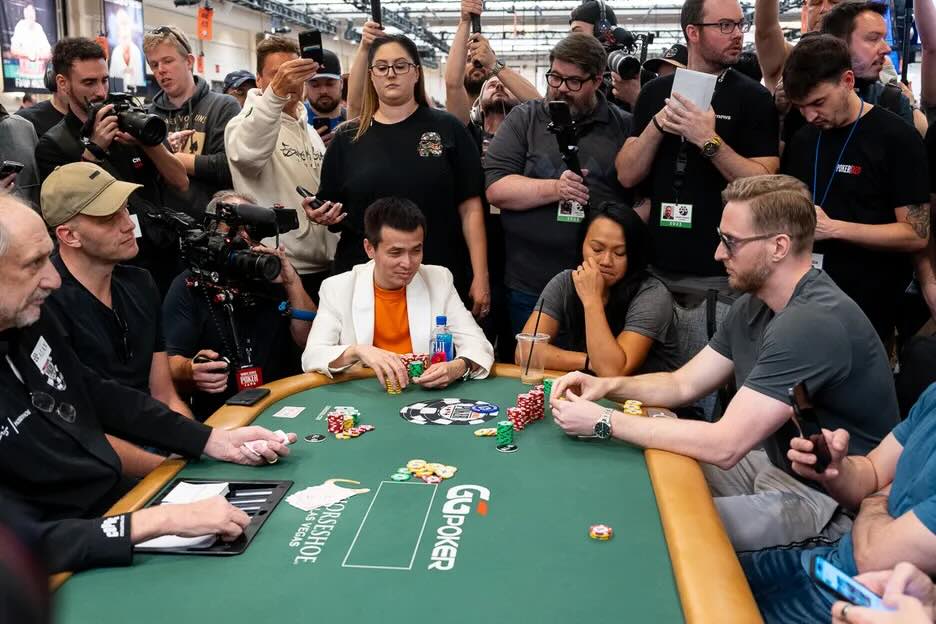
After eight years in the sleepy border town of Rozvadov, the World Series of Poker Europe has moved to Prague — and early returns suggest the gamble is paying off handsomely. The 2026 WSOP Europe, running March 31 through April 12 at the Hilton Prague (King’s Casino), features 15 bracelet events and a headline Main Event carrying a €10 million guarantee at a reduced buy-in of €5,300.
The first bracelet of the festival went to Germany’s Frank Koopmann, a self-described recreational player who took down the €3,300 Mixed PLO/PLO8/Big O event for €123,879. Koopmann defeated the formidable Shaun Deeb heads-up, closing the deal by rivering quad fours in a PLO8 hand — the kind of cooler that would make a professional wince and a recreational player frame the hand history. The field of 181 entries was stacked with names: Dario Sammartino, Benny Glaser, Stoyan Madanzhiev, Viktor Blom, Josh Arieh. For Koopmann, it was only his fourth lifetime WSOP cash.
But the bigger story is the sheer volume of players showing up. The €1,100 Opener Mystery Bounty drew 2,195 entries across four flights. The €565 Colossus attracted 2,662. And the Main Event’s Day 1A alone pulled in over 680 runners before late registration closed — already eclipsing the entire 2025 WSOPE Main Event field in Rozvadov, which topped out at 659. Two more starting flights remain.
The move to Prague also coincides with a structural overhaul of the WSOP Player of the Year race. For the first time, a unified “global season” ties together WSOP Europe, the Las Vegas summer series, and the year-ending WSOP Paradise into a single $1 million leaderboard. Deeb, despite his runner-up finish in the opening event, is already being spoken about as a leading contender. Phil Hellmuth, ever chasing bracelet number 18, has committed to a full grind in Prague. The incentives are aligned for big names to play deep schedules, and it shows in the field compositions.
Prague was always going to be a livelier host city than Rozvadov — that much was obvious from the venue announcement. What wasn’t guaranteed was that the poker community would follow. They have, emphatically.
The Irish Open Goes Global — and 5,003 Players Prove the Point
For 46 years, the Irish Poker Open has been one of those beautifully stubborn institutions in the game — the oldest no-limit hold’em tournament outside of Las Vegas, held every year in Dublin since bookmaker Terry Rogers came home from a trip to Vegas in 1980 with Benny Binion’s handshake and a wild idea. It has always punched above its weight. This year, it punched through the roof.
The 2026 Irish Poker Open Main Event, held at the Royal Dublin Society and sponsored by PokerStars and Paddy Power Poker, attracted 5,003 entries — a record by a wide margin, surpassing last year’s already-enormous field of 4,562. The €1,150 buy-in event generated a prize pool of nearly €4.85 million, almost doubling its €2.5 million guarantee. Players from 86 countries made the trip. The largest single starting flight, Day 1D, drew 2,037 runners — a number that by itself would have been considered a massive field just a few years ago. The eventual winner takes home €517,100 and one of the most prestigious titles in European poker.
But the bombshell came on Friday evening, when organisers Paul O’Reilly and JP McCann took the stage and announced something unprecedented: the Irish Poker Open is going international. Three stops have been confirmed for 2026–2027. The first lands in Sydney, Australia, in September — a ten-day festival at the Poker Palace featuring a $2,000 buy-in Main Event with a $1 million guarantee. Marrakech, Morocco, follows in November, with a six-day run at Casino de Marrakech and a €1,150 Main Event carrying a €500,000 guarantee. A third stop in the United States is slated for 2027, with the specific venue yet to be announced.
The strategic thinking here is sound. The IPO’s identity has always been rooted in accessibility — modest buy-ins, strong satellite programmes, a famously welcoming atmosphere. Exporting that model to new markets, rather than repackaging it as a high-roller circuit, preserves what makes the brand special while tapping into genuinely underserved poker communities. The Marrakech buy-in matching Dublin’s price point is a telling detail. And the stated ambition — to make the Irish Open the biggest poker tournament brand in the world by its 50th anniversary in 2030 — is audacious but, given the trajectory, not absurd.
PokerStars Comes to FanDuel — and the Sunday Million Returns to America
After months of anticipation, the new PokerStars Exclusively on FanDuel platform went live on April 1 — and no, it wasn’t a joke. The launch merges PokerStars’ brand and tournament infrastructure with FanDuel’s US market reach, creating a shared player pool across Michigan, New Jersey, and Pennsylvania for the first time. Existing PokerStars US players need to create new accounts (there’s no migration), but the welcome package is generous: a 100% deposit bonus up to $1,000 plus $30 in free tournament tickets.
The centrepiece of the launch is the return of the Sunday Million to American soil. On April 12, FanDuel Poker will run two tournaments under the Sunday Million banner: a $109 buy-in event with a $500,000 guarantee and a $1,100 buy-in event with the same guarantee, for a combined $1 million in guaranteed prizes. It is the first time the Sunday Million brand has appeared in the regulated US market since Black Friday in 2011.
Is this a permanent fixture or a one-off promotional splash? FanDuel has been cautious about committing either way. But the symbolism is hard to miss. The Sunday Million was the tournament that built PokerStars into a global powerhouse; bringing it back to the US signals a real investment in rebuilding the brand’s competitive identity in the post-Black-Friday landscape. Early traffic indicators are reportedly strong, which suggests the crossover between FanDuel’s enormous sports-betting user base and online poker may be more viable than sceptics assumed.
Around the Felt: Quick Takes
GGPoker’s April Giveaway promises $15 million in prizes across leaderboards, Flip & Go’s, and the Bounty Hunters Series. Say what you will about GGPoker’s approach to online poker, but the sheer scale of their promotional calendar remains unmatched.
PokerStars and the One Drop Foundation have partnered on a €100,000 High Roller charity event at EPT Monte Carlo, with 3% of every buy-in going towards clean-water initiatives. Poker and philanthropy have a complicated history, but this is one of the cleaner examples of the industry doing something genuinely worthwhile.
The WSOP Circuit has shifted to a calendar-year format for 2026, with domestic and international stops running from January through December. It’s a logistical change, but one that gives players far more predictability in planning their tournament calendars. The current stop at Grand Victoria Casino in Elgin, Illinois, features 18 events through April 13.
Alexander Farahi took down the WPT Rolling Thunder Championship this week, adding another title to a quietly impressive competitive resume. And at the 2026 Venetian March DeepStack Showdown, Sergei Saakian claimed three titles in five days — the kind of heater that makes you wonder whether the poker gods are on retainer.
The Charity Series of Poker runs three events in Las Vegas this month at Via Brasil Steakhouse, kicking off April 11. Poker at its best has always been a social game with a generous streak, and events like these keep that spirit alive.
The Bigger Picture
Step back from the individual stories for a moment and a pattern emerges. The game is expanding geographically — the Irish Open is going to Sydney and Marrakech, WSOP Europe has moved to a major European capital, and the WSOP Circuit is adding international stops. It is consolidating commercially — the PokerStars–FanDuel merger creates the most credible threat to GGPoker’s dominance in US online poker in years. And it is being tested legally — the Lodge raid is a reminder that poker’s regulatory status remains fragile, even in jurisdictions that have seemingly embraced the game.
These are not small developments. Five years from now, when we look back at the shape of the poker industry, early 2026 may well be one of those inflection points where several tectonic plates shifted at once. For players, for operators, and for anyone who cares about the health of this peculiar, beautiful, endlessly compelling game — it’s worth paying attention. If you are new comer into this arena, learn all about how to play poker.